
Checking Criminal History in Hampton
A Hampton record search works best as a sequence. Police2Citizen can show recent police events and wanted-list entries. Central Records provides local reports and the subject's local conviction transcript. General District Court holds misdemeanor cases and felony preliminary stages, while Circuit Court holds felony indictments, trials, and district appeals. Adult domestic criminal matters can fall within J&DR jurisdiction. Sheriff Adult Intake handles local custody information.
Use a full name, spelling variants, a rough date, and a case or event number when known. A name match alone is not enough to identify a person. Read each status and disposition in its own source, then call the record holder when the web result lacks the underlying document.
- Check Hampton P2C for a recent city police event or wanted entry.
- Request the police report or local transcript from Central Records when eligible.
- Search OCIS across the Hampton court levels that could hold the charge.
- Call Adult Intake for current custody or the correct clerk for court documents.
- Use SP-167 when the subject-consented Virginia repository history is needed.
Hampton Records in a County-Equivalent
Hampton is not a county that contains several incorporated cities. It is an independent city with county-equivalent status. That fact changes the record map. Hampton Police serves the city, state courts sit on North King Street, and Hampton Sheriff runs the local custody chain. Newport News and Poquoson are separate jurisdictions, so their police and court records must not be folded into a Hampton search.
Hampton incorporated in 1908. Its 1952 expansion absorbed Elizabeth City County and Phoebus, which helps explain why older local material may use names and boundaries that do not match today's city structure. The City's history page supplies this local background.

Modern searches should still use Hampton's current police, Sheriff, and state-court offices even when the historical place name differs.
Hampton Police Department Records
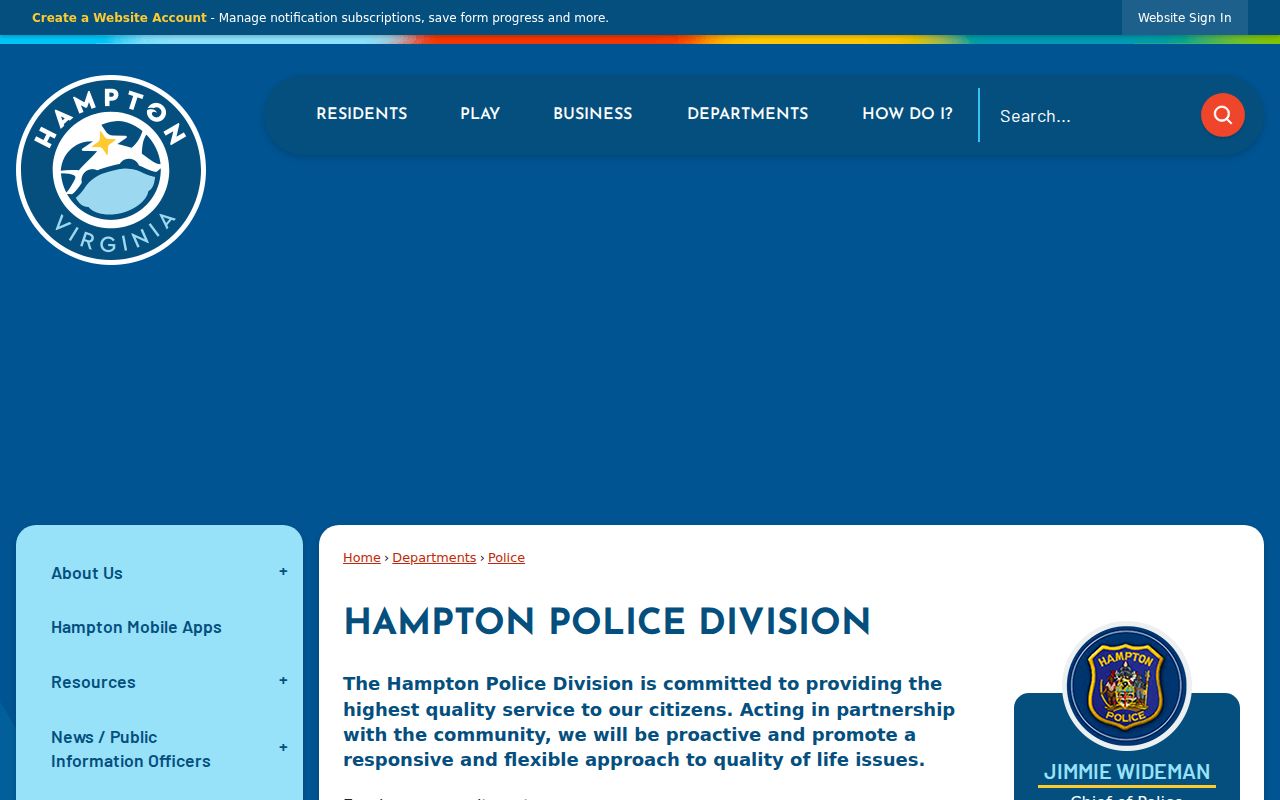
Hampton Police Division is the main city source for incident and arrest reports. Central Records operates at 40 Lincoln Street, weekdays from 8 a.m. to 5 p.m., at 757-727-6540. It handles local conviction checks, fingerprints, eligible accident and incident copies, VFOIA intake, and registry renewals or changes. The police nonemergency number is 757-727-6111.
A $15 local transcript is available only when the record subject appears with photo identification. It contains Hampton convictions, excludes juvenile offenses, and is not a statewide CCRE history. Accident copies cost $10 and are limited to authorized people such as those involved, their attorneys, or insurers. A victim or reporting person can receive the public incident copy without a copy fee, subject to identification and lawful redactions.
The official Hampton Police page identifies the local department and its public service channels.
Ask the originating agency for its narrative when Virginia State Police, Marine Police, Hampton University Police, or another special agency made the arrest.
Using Police2Citizen for Hampton Records
Hampton Police2Citizen, or P2C, provides a Daily Bulletin and a Wanted List. The Daily Bulletin can be filtered by event type and date. Its public columns include case number, description, officer, charge, name fields, race, sex, crime, location, and property. The portal marks arrest and incident events and distinguishes attempted or completed, felony or misdemeanor entries. It warns that some events do not appear on the same day.
The Wanted List includes a Show All control and fields for name, race, sex, age, charge, paper type, address, and agency. Age reflects the event date, not necessarily current age. The list is not promised as complete or current, so confirm a possible warrant with Hampton Police or the issuing court before acting.
| System | Input | What it helps find |
|---|---|---|
| P2C Daily Bulletin | Event filter, bulletin date, Update | Public arrest and incident event rows |
| P2C Wanted List | Show All | Public wanted fields needing verification |
| OCIS 2.0 | Name, case, hearing date, court | Docket status and disposition |
| GovQA | Account and request details | Public-record request tracking |
The official Hampton Wanted List displays the search controls and public column headings.
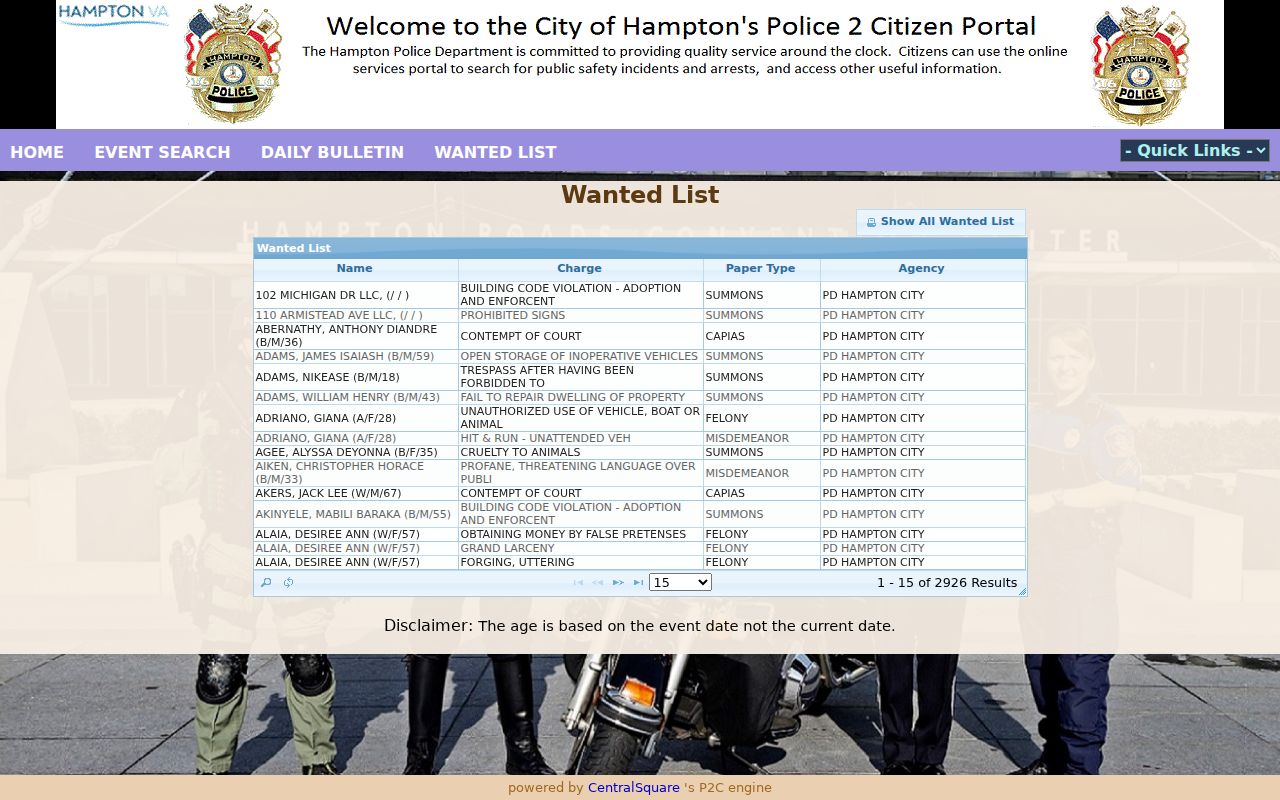
P2C is a web portal. Hampton's Atlas One service provides police alerts and tips, but it is not an inmate, warrant, or criminal-record lookup replacement.
Hampton Arrests and Bookings
Hampton Police keeps responsibility from arrest through delivery to Sheriff Adult Intake. The officer completes the arrest sheet and related report, sends warrants or commitments with the person, identifies the receiving official, and passes on operational safety information. Sheriff staff then open the separate Jail Management System record for intake, property, housing, court movement, and release calculations. Fingerprints and reportable arrest data move toward state identification and CCRE reporting.
No current official Hampton online inmate roster is linked. A P2C event does not establish present custody. Call Adult Intake at 757-727-6596 or the Sheriff's custody line at 757-727-6760. The Sheriff main office is 757-926-2540. If a person has moved to state custody or supervision, the VADOC locator is the next official route. Virginia VINE provides custody and release alerts.
For fuller county-equivalent channel detail, use the Hampton arrest lookup after checking the city police event.
Hampton Crime Reports Are Not Convictions
Hampton's official 2024 Group A table counts 9,642 reported offenses. It includes 3,552 larceny entries, 2,035 simple assault or intimidation entries, 1,952 shoplifting entries, 1,321 vandalism entries, and other offense groups. These are report counts, not convictions and not a count of unique people. One event can generate a police report without producing a filed charge or guilty finding.
The official annual crime statistics page provides tables covering 2012 through 2025.
Use the tables for trend and context. Use the police file for the event, OCIS and the clerk for a case outcome, and CCRE for the official state history available through its lawful channels.
Municipal Court Records in Hampton
Hampton has no separate municipal court. Virginia's state courts perform the local criminal court work. Hampton General District Court hears misdemeanors and traffic cases and conducts felony preliminary hearings. Circuit Court tries felony cases, receives grand-jury indictments, and hears district appeals. J&DR handles juvenile delinquency and covered adult domestic or family criminal matters, with juvenile access restricted.
| Local court structure | Virginia General District, Circuit, and J&DR courts; no Hampton municipal court. |
|---|---|
| General District | 236 N. King Street; misdemeanors, traffic, and felony preliminary stages. |
| Circuit Court | 237 N. King Street; felonies, grand jury, and district appeals. |
| J&DR Court | 220 N. King Street; juvenile and statutory adult domestic or family cases. |
| Case lookup | OCIS by name, case number, or hearing date, followed by the right Hampton court. |
| Documents | Request nonconfidential files or certified copies from the responsible clerk. |
OCIS 2.0 generally displays case data rather than free document images. Search later court stages when a district docket says a felony was certified or a misdemeanor result was appealed.
Mapping Hampton Public Safety Data
Hampton's Open Data project adds a community crime map, a five-year comparison, officer-involved-shooting reports dating to 2008, staffing information, public events, and a citizen survey. The map can add place context around Downtown, Phoebus, Buckroe, Fort Monroe, Fox Hill, Wythe, and Coliseum Central. It does not turn reported events in a neighborhood into convictions.
The Hampton Police Open Data Project shows these public-safety tools.
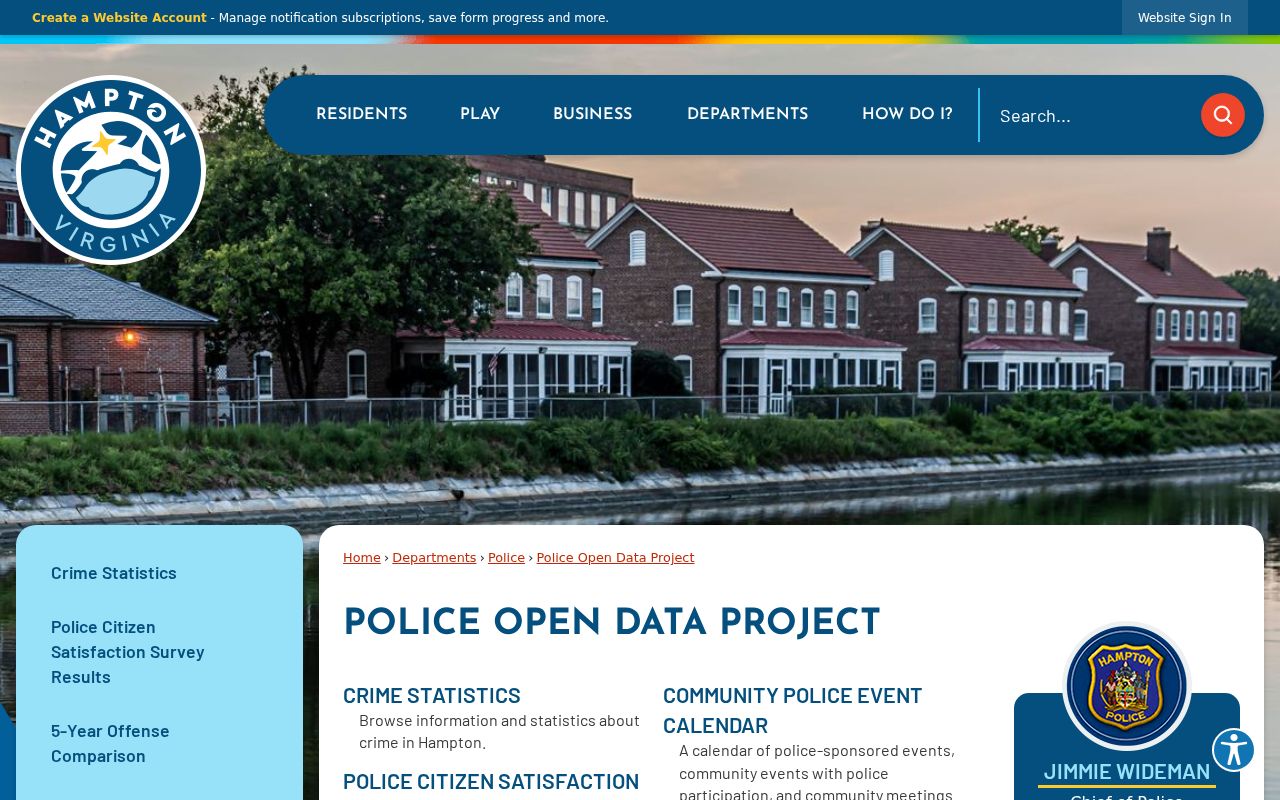
Geography matters in Hampton because the independent city spans port, shoreline, military, university, highway, and residential areas. Still, the source record remains with the police agency, court, Sheriff, or state office that created it.
Where Hampton Records Go
Hampton records move on separate tracks. A police incident stays in the originating agency's records system. A custodial arrest creates a Sheriff intake record. The clerk opens the criminal case and later reports its disposition. For a reportable arrest, fingerprints and arrest data reach CCRE, where the court result should attach to the arrest cycle. A mismatch or unapplied disposition can leave an incomplete state entry until the contributor corrects it.
Record flow: Hampton Police Division › Hampton Courts › Virginia State Police CCRE.
Recent activity may appear first in P2C. The filed charge belongs in the correct court. A final Virginia history comes through SP-167 with the subject's consent. For an identity error, use the Virginia State Police challenge steps and contact the contributing agency rather than asking a court clerk to edit police or CCRE data.
Hampton FOIA Record Requests
Hampton accepts Virginia Freedom of Information Act requests through GovQA, phone, email, fax, mail, or in person. A request can be oral and need not cite VFOIA. It should describe an existing record with enough detail for staff to locate it. Ask for a specific incident, CAD event, body-camera record, crash, call-for-service entry, or 911 item by date, time, location, and case number when known.
The City generally responds within five working days by producing, redacting and producing, denying with a legal basis, asking for clarification, or invoking more time. Actual costs can apply, and a deposit may be required when an estimate exceeds $200. The Hampton Police form warns that 911 audio older than 180 days is unavailable under its retention rule, so those requests should be made promptly.
Hampton Warrants and the Magistrate
The Hampton Magistrate is at 236 N. King Street and operates continuously. Magistrates decide probable cause for process and act on bail within their authority, but the office does not disclose pending-charge information. The official route sends warrant or summons questions to Hampton Police at 757-727-6626 and inmate questions to the Sheriff at 757-727-6760.
A P2C wanted entry is not conclusive. General District Court at 757-727-6260 or Circuit Court at 757-727-6105 may have case history that shows a capias or failure-to-appear event. Confirm the status and obtain instructions before appearing based only on a public list. A search-warrant inventory and return is filed with Circuit Court within the statutory time unless a court seals it.
Hampton and State Record Boundaries
The $15 Hampton transcript is a city product for local convictions. OCIS is a public court docket. SP-167 is a consent-based search of Virginia's CCRE. The VADOC locator covers state inmates and supervisees. None of those sources supplies every incident narrative, booking calculation, court pleading, and national fingerprint entry.
For a recent Hampton event, begin locally. For a case outcome, use OCIS and the clerk. For the subject's Virginia repository history, generate SP-167, complete the notarized signatures, and mail it with the correct payment. For the subject's national fingerprint history, use the FBI Identity History Summary route. Each product has a different legal source and scope.
Public Access Rules in Hampton
Virginia law controls what Hampton Police, the Sheriff, courts, and CCRE may release. Adult arrestee identity, charge, and arrest status are generally public under the criminal-investigative provisions of VFOIA, subject to lawful withholding and redaction. Nonconfidential Circuit clerk records are open for inspection and copying at reasonable cost. CCRE histories are limited to the recipients and purposes listed in state law.
Key statutes:
Virginia Freedom of Information Act governs City public-record requests and criminal-investigative disclosure.
Virginia Code § 17.1-208 governs access to nonconfidential Circuit clerk files.
Virginia Code § 19.2-389 limits CCRE criminal-history dissemination.
Juvenile records, protected victims and minors, Social Security numbers, financial accounts, and some investigative or supervision data remain restricted. A public docket should never be treated as proof that every related record is open.