
Hampton County Criminal Court Cases
Hampton is an independent city and Virginia county-equivalent, so there is no separate county courthouse or municipal court. The local criminal case file belongs to one of three state courts. Hampton General District Court tries misdemeanors and traffic cases and holds preliminary hearings in felony matters. Hampton Circuit Court, part of the Eighth Judicial Circuit, hears felony indictments, felony trials, and appeals from General District Court. Hampton Juvenile and Domestic Relations District Court handles juvenile delinquency and adult criminal matters within its family and domestic jurisdiction.
The clerk for each court is the custodian of its own docket and nonconfidential case papers. That split matters. A felony may begin in General District Court, move to a Circuit Court indictment, and leave separate entries in both systems. Court staff can locate pleadings, orders, certified dispositions, and older files. Police Central Records cannot provide those court documents because its incident reports and local conviction transcript are separate products.
The official Circuit Court page shows the clerk office that holds Hampton felony records.
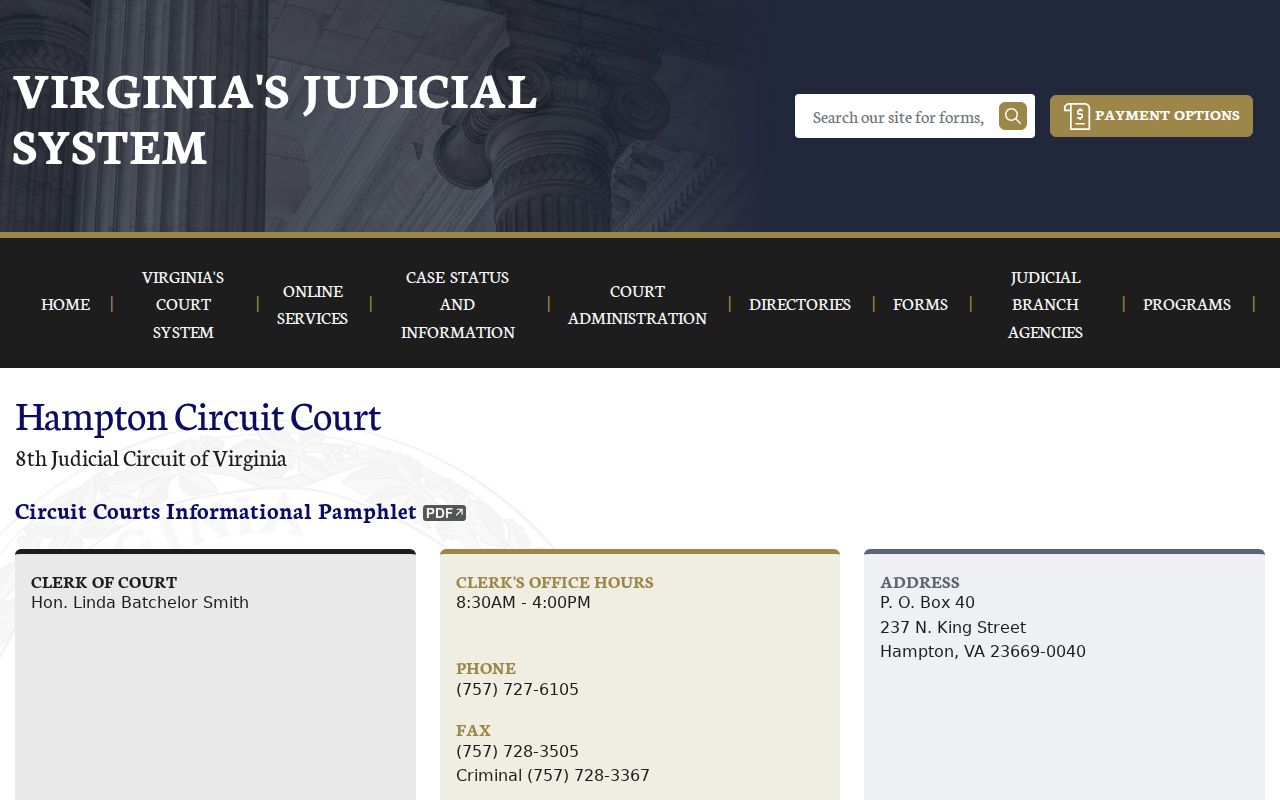
This source is the right starting point for a nonconfidential felony file or a certified Circuit Court disposition.
Searching Hampton Cases in OCIS
Virginia OCIS 2.0 is the free statewide public docket search. It includes criminal and traffic matters in General District Court, adult criminal matters within J&DR jurisdiction, and records from participating Circuit Courts. OCIS is a court index, not a Virginia criminal-history report. It does not accept payments, and it generally shows docket data rather than free images of pleadings or orders.
The OCIS landing page displays the statewide controls used for Hampton criminal case records.
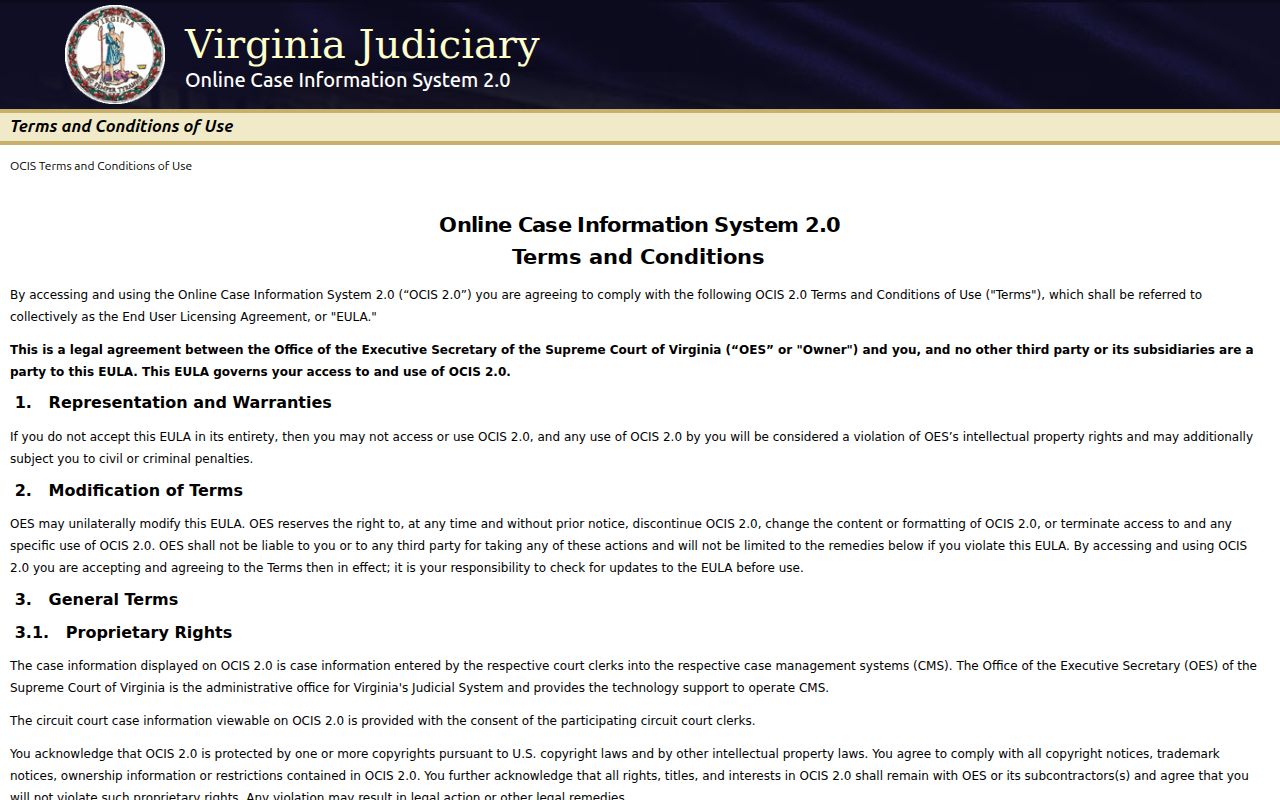
Its court-level and locality choices are essential because the same defendant or felony can appear at more than one Hampton court stage.
| OCIS control | Type | Required | Use in a Hampton search |
|---|---|---|---|
| Search By | Tabs | Yes | Name, Case Number, or Hearing Date |
| Court Level | Selector | Yes | All levels or one court level |
| Court | Selector | Yes | Choose Hampton; a case-number search permits one court |
| Name | Text | Conditional | Used on the Name tab |
| Case Number | Text | Conditional | Format is checked against the selected court |
| Hearing Date | Date or range | Conditional | Used to find matters set for hearing |
Searching Hampton County Case Records
Use the narrowest reliable detail first. A full case number is stronger than a name, but it only works after the correct court is selected. Name results can belong to different people, and the public display may not reveal enough birth information to prove identity. Check later events before treating an early docket entry as the final outcome.
- Open OCIS and choose Name, Case Number, or Hearing Date.
- Select the relevant court level and Hampton locality. Try General District and Circuit for a felony that moved forward.
- Enter the exact case number or the best-known name and apply any available advanced filters.
- Open the matching docket and review its court, charge, events, status, disposition, sentence, and appeal data.
- Contact the clerk that owns the file when an order, certified copy, archived record, or document absent online is needed.
If OCIS produces no match, verify spelling and court level, then try the Hampton-specific legacy Circuit interface. Call the correct clerk with the best-known case number, charge date, and court. Ask whether the file is active, archived, stored on another medium, sealed, or held by another Hampton court. That fallback is safer than assuming no record exists.
One Hampton Felony, Two Courts
A felony can leave a General District Court entry even when Circuit Court will conduct the trial. General District holds the preliminary hearing, which tests whether probable cause supports sending the charge forward. It does not decide guilt. A certification to the grand jury means the matter advances. The Circuit grand jury may return a “true bill,” which is an indictment, or a “no bill,” meaning it declined that proposed indictment.
The General District Court source identifies Hampton's misdemeanor and felony preliminary-hearing court.
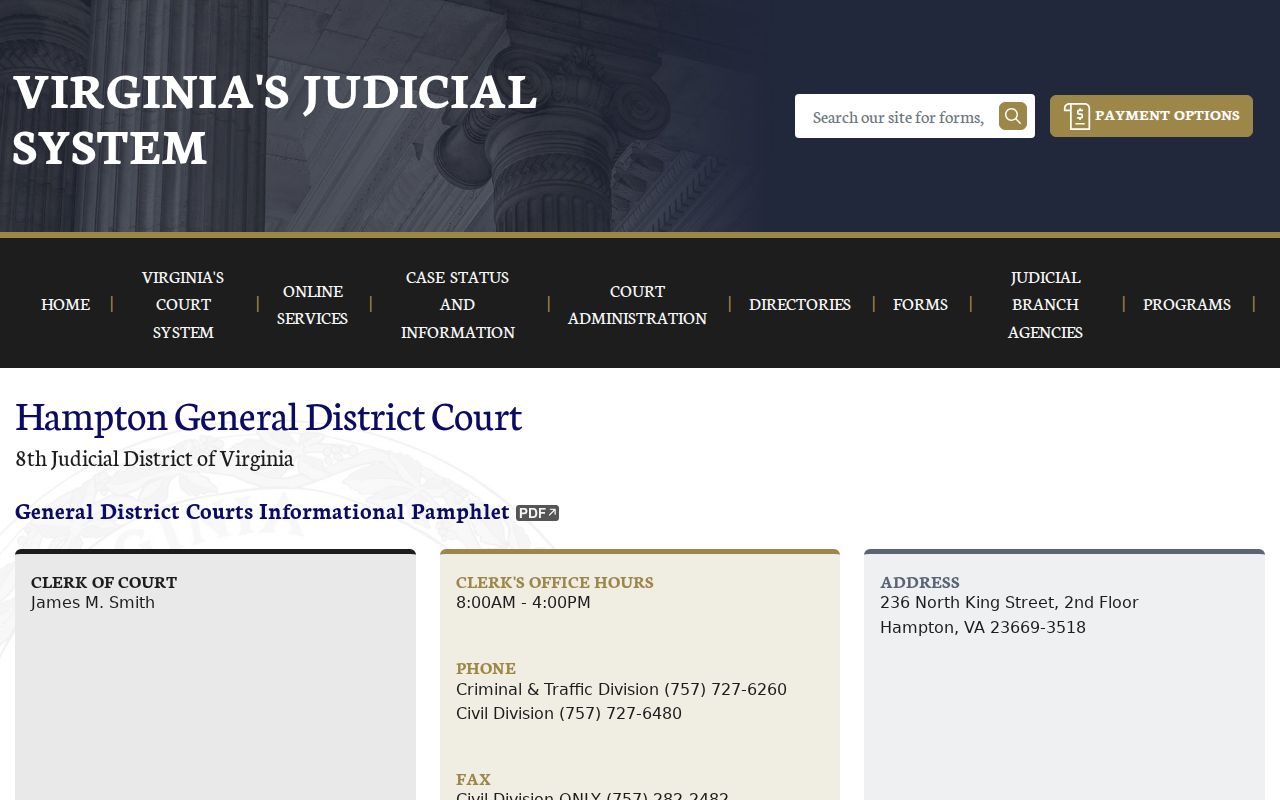
The split explains why a searcher should follow the later Circuit docket instead of reading the first court's entry in isolation.
A misdemeanor appeal creates another trap. Appeals from General District Court are heard de novo in Circuit Court, meaning the Circuit Court conducts a new trial rather than just reviewing the lower docket for error. When the first record says “appealed,” check the Circuit case to find the operative outcome.
Inside a Hampton County Case File
A Hampton criminal case record can identify the court and locality, case number, displayed defendant, case type, and key dates. It may also show the filed charge, code section, offense degree, hearing history, counsel, case status, disposition, sentence, fines, costs, payments, and appeal information. The docket is a chronology. A listed motion or hearing proves that the event was filed or set, not that every allegation in it was accepted.
| Case Number & Court | Identifies the file and the clerk responsible for it. |
|---|---|
| Charging Document | States the accusation filed by complaint, warrant, summons, or indictment. |
| Docket Entries | Lists hearings, filings, motions, continuances, and orders in date order. |
| Hearing Dates | Shows past and scheduled court events. |
| Disposition & Judgment | Records whether a charge ended in conviction, acquittal, dismissal, or another result. |
| Sentence & Conditions | May show confinement, suspended time, probation, fines, costs, and restitution. |
OCIS detail does not replace the underlying file. For a signed order, charging instrument, or certified disposition, ask the clerk. Sensitive identifiers and protected victim or minor information can be redacted, while juvenile matters do not receive the same public access as adult Hampton cases.
Reading Hampton Case Outcomes
The outcome field deserves more weight than the opening charge. Virginia docket terms can look alike but have different meanings. “Nolle prosequi” means the prosecution discontinued that charge without a guilt finding. A dismissal also ends the charge, while an acquittal is a not-guilty result after judicial action. None is a conviction. A pending case has not reached its final disposition.
- Certified to grand jury
- The preliminary stage found enough cause to send a felony toward Circuit Court.
- True bill
- The grand jury returned an indictment.
- No bill
- The grand jury declined the proposed indictment.
- Deferred disposition
- A plea or finding is held while the person completes set conditions.
- Concurrent sentence
- Two or more terms run at the same time.
- Consecutive sentence
- Terms run one after another.
A dismissal or acquittal does not, by itself, erase a police arrest record or a CCRE entry. Likewise, bond is security for release and is not the same as a sentence balance. Read each field for its own purpose.
How a Criminal Case Moves
A Hampton case may start with an arrest or with a summons, so no booking record is required for a court case to exist. After a custodial arrest, Adult Intake paperwork and the magistrate's probable-cause and bail work come before the formal trial docket. At arraignment, the accused receives notice of the charge and rights; the court addresses counsel and bond and sets the next stage.
Case flow: Charges Filed › Arraignment › Pretrial › Plea or Trial › Disposition › Sentencing
For a felony, General District or J&DR within its jurisdiction may conduct the preliminary hearing. An indictment places the felony in Circuit Court, where pretrial motions can address evidence, discovery, or scheduling. A conviction can follow a plea or trial verdict. Sentencing may include confinement, suspended time, probation, a fine, costs, and restitution. A Circuit criminal appeal then proceeds through Virginia's appellate courts.
Hampton Charges and Prosecution
Virginia calls the local prosecutor the Commonwealth's Attorney, not a district attorney. Hampton's Commonwealth's Attorney prosecutes felonies and serious misdemeanors, along with domestic violence matters and other assigned cases. The office may also respond in an eligible expungement case. Yet the prosecutor does not act as the public custodian of the court file. Requests for pleadings, orders, and certified case outcomes still go to the clerk.
The official prosecutor page describes the office's place in Hampton criminal court cases.
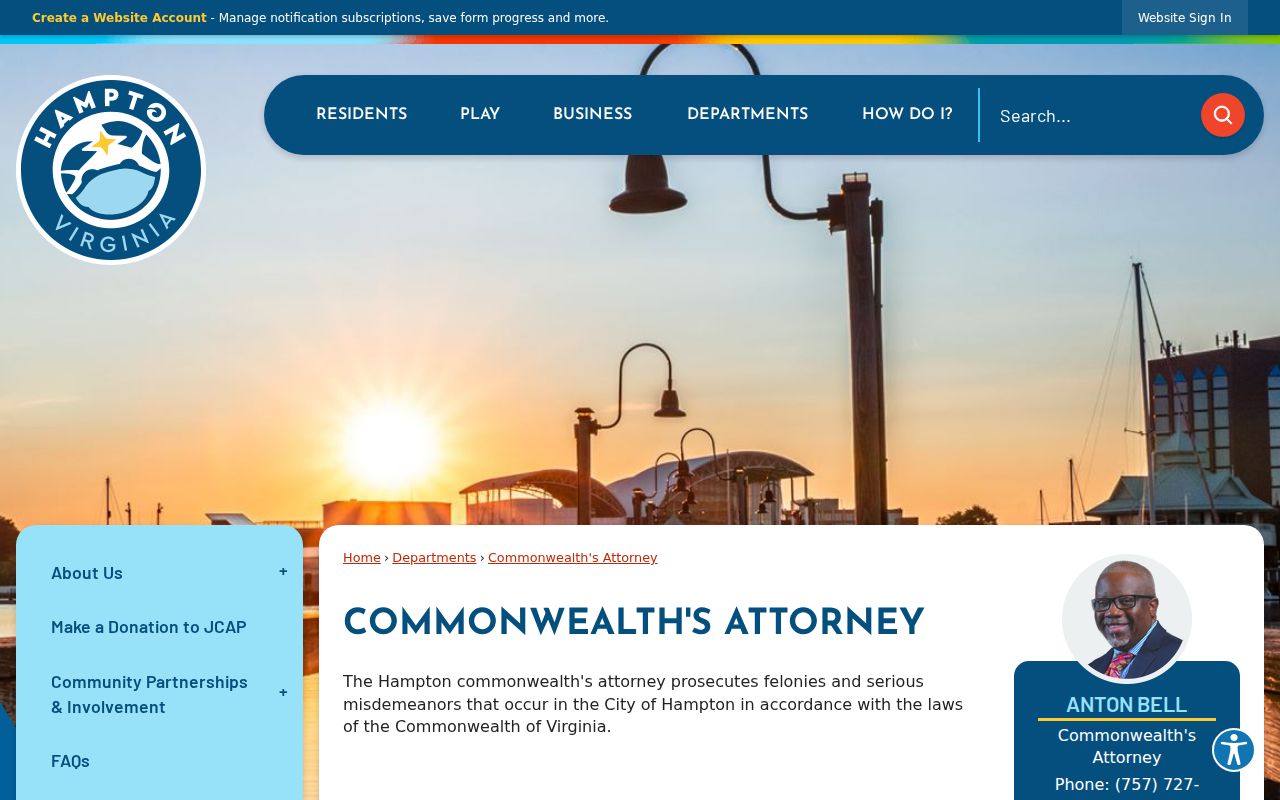
This division of roles prevents a common mistake: the prosecutor presents the Commonwealth's case, while the clerk maintains the judicial record.
Charges can change as a matter moves through court. A complaint, preliminary-hearing result, grand-jury indictment, plea agreement, and final judgment can therefore describe different points in one prosecution. The latest signed order and disposition provide stronger evidence of the outcome than the original accusation alone.
Federal Cases Near Hampton
Federal criminal matters arising around Hampton do not appear as state prosecutions in the local Circuit or General District files. Hampton falls within the Newport News Division of the U.S. District Court for the Eastern District of Virginia. Federal dockets use PACER, while courthouse terminals provide free access to opinions and some records. PACER currently charges $0.10 per page, with a $3 cap for case-specific documents and reports; quarterly fees of $30 or less are waived.
The Eastern District's Newport News page identifies the nearby federal courthouse serving Hampton.
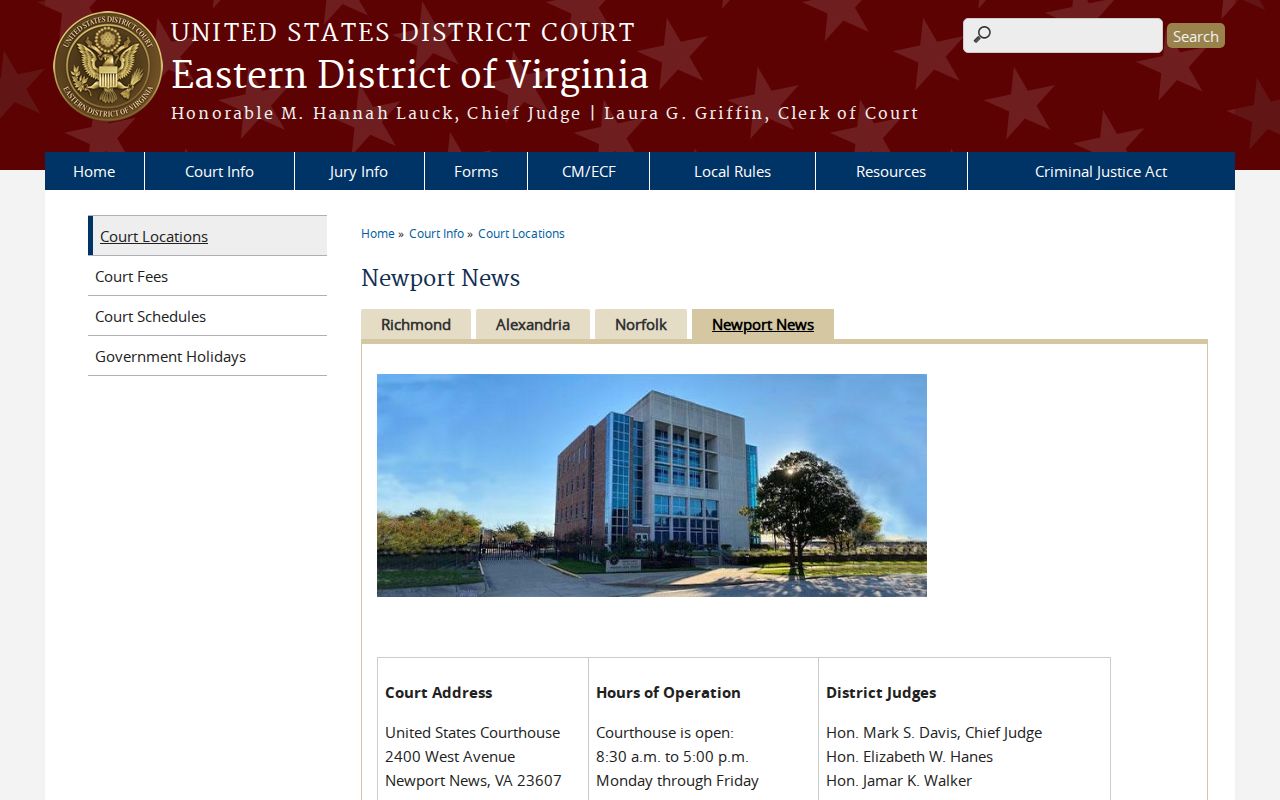
Use that federal source when the charge was brought by the United States rather than the Commonwealth of Virginia.
Case Record Access & Restrictions
Virginia law treats many nonconfidential Circuit clerk records as open for inspection and copying. Virginia Code § 17.1-208 governs access to individual Circuit files and permits reasonable copying costs. It also distinguishes a request for one file from a bulk data request. Ask the clerk to confirm any copy or certification charge because the research did not find a dependable current Hampton fee schedule.
Juvenile records are generally confidential, and public versions may omit protected victim details, Social Security numbers, financial account data, and other sensitive identifiers. Sealed or expunged matters leave ordinary public view but may remain available for uses authorized by law. A person reviewing an apparently wrong result should first confirm the exact court and case number, then ask the originating clerk or contributing agency to identify the correction path.
For a broader view beyond a single docket, the Hampton criminal records overview explains why court, police, custody, and Virginia repository products do not contain the same information.